We’ve passed +1.5°C above pre-industrial temperatures. +2.4°C is now unstoppable. Recent projections show we’re on track to reach +3.0°C by 2050, at which time billions will die by mass migration due to unlivable heat, agriculture collapse, social upheaval, and war.
Time – Meet at 11:30am Start Location – St Mary Le Strand Start time – 12:00pm Nearest tube stop – Temple (Circle & District lines) End Location – Parliament Square – Silent vigil to be held in Parliament Square from 1pm – 1:30pm.
Join us for a post action debrief in St James Park with food, speeches and small group discussion.
Come along to our Open Call on 22nd June from 19:00 – 20:00 to find out why 4BD is taking to the streets again!
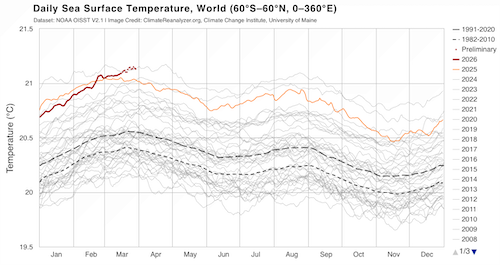
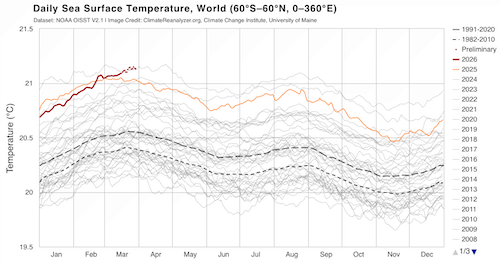
“The Nino index (Nino3.4) has just reached Nino-neutral, but global SST (sea surface temperature) has matched the highest level for this date, which was achieved during the last El Nino. Super warming is clear. Look for a global temperature soon of at least +1.7C, even if the “Super” El Nino turns out to be half-baked. The University of Maine Climate Change Institute has a spectacular interactive graphic that they update daily. It is a valuable research and communications tool.” – James Hansen // https://climatereanalyzer.org/clim/sst_daily/?dm_id=world2
Bad news is, that there is no next economy: so called “renewables” and batteries use the same raw materials and rely on the same processes as the old, fossil fuel economy. If anything the new, electrified economy has become even more reliant on oil than its “predecessor” ever was. No oil, no green energy either.
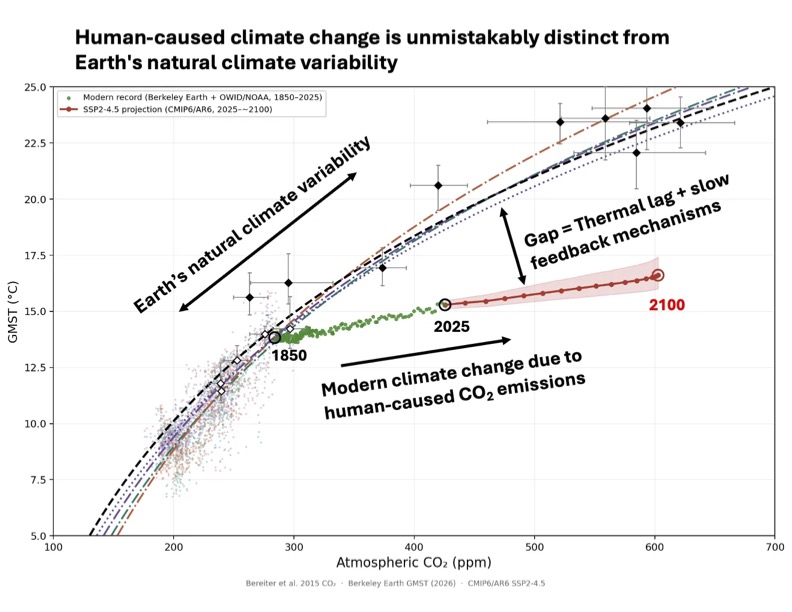
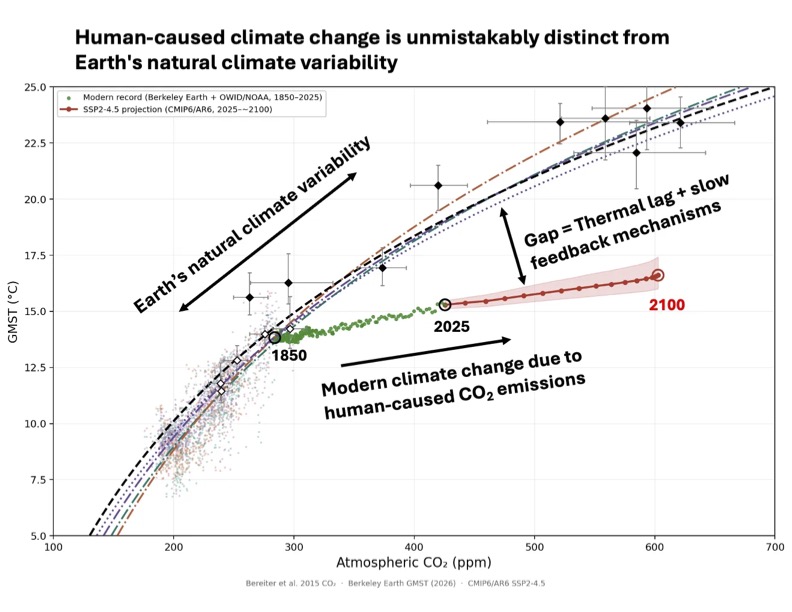
Five independent fits of Earth’s natural CO₂–temperature relationship — derived from different archives, different methods, and different timescales — all land in the same tier. That relationship holds from the depths of the ice ages to warm greenhouse climates with no continental ice, across 66 million years of Earth history. The modern trajectory departs from it at 1850 and has not looked back. The departure is not subtle, not a matter of interpretation, and not an artifact of any single dataset or method. It is unmistakable.
3°C by 2050 Is Not a Prediction. It’s a Risk. And It’s 25 Years Away, by Peter Dynes.
Dr. Klaus Richter, President of the German Physical Society, states that the world could plausibly reach 3°C of warming by 2050. It’s not the most probable outcome,” he said. “But it is a risk we cannot exclude — and because the damage would be so large, it must be taken seriously.” That distinction matters. This is not a headline-driven forecast designed to shock. It is a risk assessment grounded in physics and informed by emerging signals in the climate system. Read Peter’s Substack Post:
So today, I invite those of you who haven’t already, to join my fierce cult of hardcore collapse realism, because at some point you have to respect yourself and stop showing compassion for a civilisation that never had compassion for itself. Capitalism, ecocide, autocracy and cannibalism are self-destructive chemical reactions that only stop when there is nothing left to destroy.
It seems like many people out there are still sniffing techno-hopium by the tank-load.
As much as I’d love for them to be right, it’s just too easy to show why they’re wrong. Or at least how they’re overrelying on unreasonable assumptions.
Today, let’s talk about carbon capture and storage. CCS. The “get out of jail free” card for the fossil fuel industry. The darling of politicians who want to look like they’re doing something about the climate crisis, without actually changing a thing.
But here’s the truth: CCS is a mirage. It makes great promises, but delivers little.
Since our future fossil fuel supply looks increasingly limited, and since every low-carbon energy source continues to depend on cheap coal, oil and gas, there will come a day when electricity generation will also peak, then decline. Such shortfalls in production are usually managed with price increases, forcing customers to use less or simply go bankrupt. (Oh, the beauty of capitalism and free markets!) There is already a bidding competition between data centers, large corporations and everyone else. As a result small businesses and many households are already at a growing risk of being priced out of the electricity market. For many electric bills are already so high that they will either have to close shop soon or stop paying their dues — so that new data centers can churn out even more AI-generated cat videos.
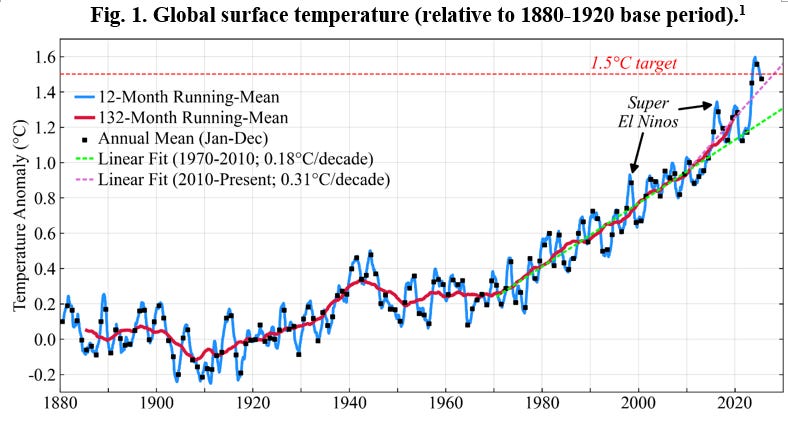
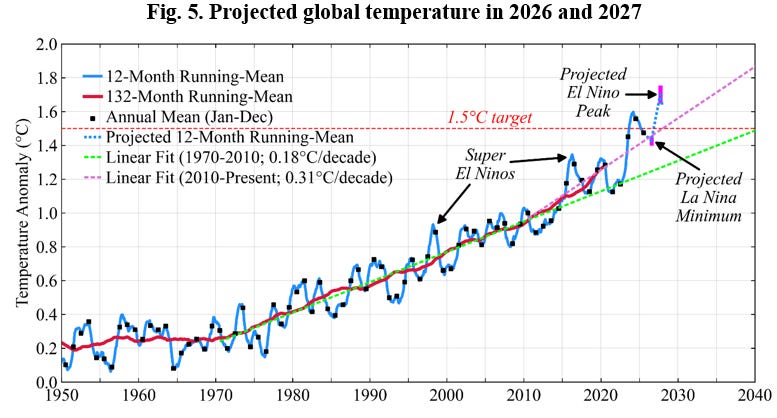
Abstract. Global temperature in 2025 declined 0.1°C from its El Nino-spurred maximum in 2024, making 2025 the second warmest year. The 2023-2025 mean is +1.5°C relative to 1880-1920. The 12-month running-mean temperature should decline for the next few months, reaching a minimum about +1.4°C. Later in 2026, we expect the 12-month running-mean temperature to begin to rise, as dynamical models show development of an El Nino. We project a global temperature record of +1.7°C in 2027, which will provide further confirmation of the recent global warming acceleration.
Global temperature of +1.47°C in 2025 relative to 1880-1920 is the 2nd highest in the period of instrumental data, about 0.1°C cooler than the 2024 record high (Fig. 1) in the GISS (Goddard Institute for Space Studies) analysis.[1] (We assume the remainder of this month will be about 0.1°C cooler than the same period in 2024; this uncertainty in the exact December temperature has imperceptible effect on the 2025 temperature in Fig. 1). The 3-year (2023-2025) temperature is +1.5°C relative to 1880-1920. We will provide details on the geographical and temporal temperature change in a communication in early 2026.
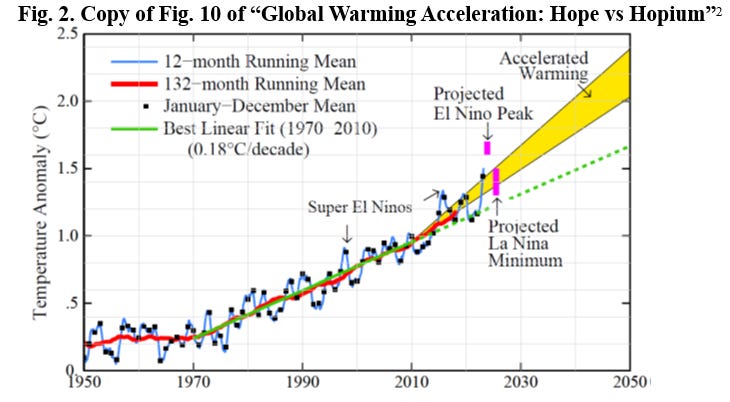
Two years ago (29 March 2024) we projected[2] that global warming in the then-ongoing El Nino would rise much more than in prior El Ninos, raising global temperature to at least +1.6°C, and that temperature after the El Nino would fall only to +1.4°C (see Fig. 2). (Expectation of unusual warming was based on realization that a long-term global cooling effect of aerosols had recently shifted to warming, as we will discuss further in an upcoming post.) Consistent with this prior projection, we expect a minimum 12-month running-mean temperature of about +1.4°C to be reached in the first half of 2026, after which global temperature should begin a rise that will continue into 2027, reaching a new record high, as discussed below.
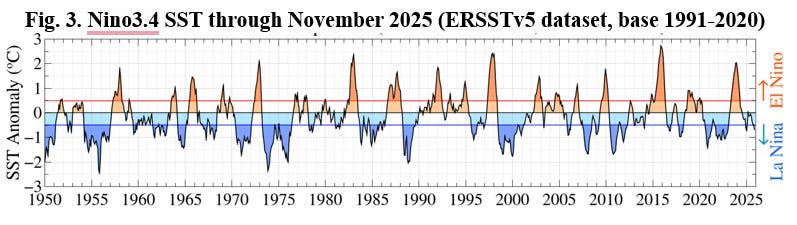
El Nino status. The tropical Pacific Ocean is presently in its cool La Nina phase, but there is evidence in numerous models that it will shift into the El Nino phase in 2026. Fig. 3 is the sea surface temperature (SST) anomaly (relative to the base period 1991-2020) in the Nino3.4 region in the tropical Pacific Ocean. This Nino3.4 index characterizes the El Nino Southern Oscillation (ENSO) status, which is the largest natural source of global interannual temperature variability. Warm or cold anomalies need to exceed 0.5°C for several consecutive months to qualify as El Nino or La Nina. Beware that rapid global warming of the past half century is perturbing the quantitative significance of Nino3.4.[3] The strongest El Nino relative to its surroundings was the 1997-98 El Nino; the 2015-16 and 2023 El Nino strengths are exaggerated by the effect of global warming on the Nino3.4 index, which also diminishes apparent strength of recent La Ninas.
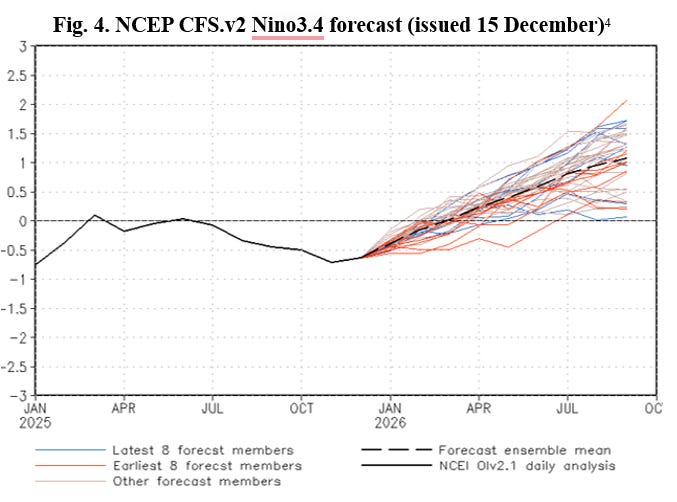
NOAA’s ENSO projections are very conservative, the 15 December ENSO Alert concluding “La Nina is favored to continue for the next month or two, with a transition to ENSO-neutral most likely in January-March 2026 (68% chance).” This is more a statement of current conditions, rather than a prediction. Numerous models and evidence point toward an El Nino beginning in the second half of 2026. For example, Fig. 4 is an ensemble of projections of the current NOAA NCEP (National Center for Environmental Prediction) model.[4] We can use the well-founded expectation of this upcoming El Nino for a further test of global warming acceleration.
Global warming projection. Assumption of at least a moderate El Nino beginning in 2026 leads us to the projection in Fig. 5, with global temperature reaching a minimum at or above +1.4°C within several months and then rising to a record global temperature of about +1.7°C in 2027. This new record will occur only four years after the 2023 El Nino, so additional, underlying, global warming at the accelerated rate of 0.31°C per decade is only about 0.1°C.
Why play this “prediction” game? The purpose is to test and advance understanding, as described in Sophie’s Planet (expected completion in the Spring of 2026) with reference to the late Wally Broecker “…the quality of Wally that I admire most was his courage to speculate. Progress in science depends on people who have the knowledge and the courage to attempt an interpretation of available data, which are always incomplete and contain measurement flaws. This quality is the antithesis of scientific reticence.[i] Sometimes Wally’s proposed interpretations were criticized as a “house of cards,” and, indeed, they often came tumbling down, but, even in such cases, he stimulated research. Other scientists criticized his proposal, flaws were exposed, and improvements were made – that is how scientific progress is made rapidly.”
[4] NOAA National Center for Environmental Prediction forecasts are available and updated weekly. A new ensemble of climate model runs is made each week. Chart 24 in their Weekly ENSO Evolution, Status and Prediction shows the average of other global atmosphere-ocean models as “DYN AVG.”